Beyond “Build vs. Buy,” Part 2: Turning Domain Expertise Into Production-Ready AI

Part 1 of our series argued that “build or buy?” is not the first question. First, determine where the business value comes from, what is strategically important, what you need to own, and how much cost, risk, and complexity the opportunity justifies. Once those questions are clear, the next challenge is execution: how do you turn domain expertise into a product that is secure, scalable, operable, and ready to create measurable value?
Thomas Edison is famously credited with saying:
“Genius is 1% inspiration and 99% perspiration.”
The lesson is not simply that execution requires more work. Success depends on directing that work toward the parts of the product that create differentiated value, rather than spending most of your energy rebuilding technology that already exists.
If you possess deep industry expertise, access to the right workflows and data, and a credible problem worth solving, you may already have the hardest-to-replicate part of an AI product. The challenge is turning that expertise into something secure, scalable, operable, and ready for customers or employees to use. Let’s explore how to cross that gap while protecting your secret sauce: the domain knowledge, data, customer access, and feedback loops that can become your moat.
The Execution Gap: Why Expertise Stalls After the Prototype
Modern AI tools have made it dramatically easier to create a compelling prototype. They have not made production equally easy. A reliable enterprise product still needs security, governance, data orchestration, integrations, identity and permissions, monitoring, auditability, evaluation, support, and a plan for continuous improvement.
This friction is one of the main reasons promising AI initiatives stall between prototype and production. Others include weak business ownership, poor data readiness, unclear economics, and insufficient user adoption. A demo can prove that an idea is possible. It does not prove that the workflow is valuable, the economics work, the output is trustworthy, or the organization can operate the product over time.
That is the execution gap: the distance between having the right idea and building a reliable vehicle to deliver it. Too often, domain experts become accidental infrastructure managers, spending time and capital on the mechanics of software instead of the specialized workflows that create competitive advantage.
Key Insights
- Prototype vs. Production: Demos prove technical feasibility, but do not prove workflow value, reliability, operational feasibility, or user adoption.
- The Infrastructure Trap: Domain experts often become accidental infrastructure managers, wasting capital and focus on software mechanics instead of their core competitive moats.
Two Starting Points, One Objective
The constraints are different for entrepreneurs and established enterprises, but the objective is the same: move beyond the prototype and create something effective, secure, and ready for serious business.
For Entrepreneurs: From Vision to Market
You have a market-defining idea and a clear view of how AI could transform a niche. You need speed, agility, and a path to your first product and customer, but building a full production foundation from scratch can consume scarce capital and attention. Vibe coding may help prove the concept, but an enterprise buyer will still expect security reviews, compliance evidence, reliability, support, and integration readiness.
For Enterprise Leaders: Modernizing Without Breaking What Works
You are starting with an established business, valuable data, proven processes, and systems that already keep the company running. The opportunity is not to replace everything. It is to intelligently modernize the workflows where AI can create measurable value without disrupting the foundation of the business.
In many organizations, leadership has made AI-enabled productivity, automation, or innovation a strategic priority. The challenge is ensuring the mandate produces business outcomes rather than activity for activity’s sake (eg: #tokenmaxxing). That requires clear KPIs or OKRs, an accountable owner, a baseline for comparison, and a decision framework for whether to stop, iterate, or scale.
Enterprises must also navigate organizational realities: fragmented versus centralized ownership, competing priorities, procurement requirements, risk governance, cultural challenges, and resistance to transformation. These factors can be just as important as the technology.
The Expertise Gap in Established Industries
Established industries like commercial real estate, construction, and manufacturing are full of complex workflows shaped by years of professional judgment. Many organizations in these sectors have deep domain knowledge and sophisticated internal systems, but they may not have spare product-engineering capacity—or a complete AI operating stack—needed to turn specialized workflows into scalable software.
You may understand the “what” and “why” better than anyone. The missing piece is often the technical and operating “how.”
Hiring engineers may be part of the answer, especially when the product is core IP. But assembling developers is not the same as establishing product leadership, architecture governance, security operations, quality assurance, and long-term ownership. For leaders without a technical background, it can also be difficult to evaluate talent, architecture, velocity, and technical debt before costly mistakes appear.
These industries are also appropriately cautious. Reliability, professional standards, and proven value matter more than novelty. That makes controlled pilots and close collaboration with design partners especially useful. A strong pilot should validate more than whether the technology works. It should test the workflow, accuracy thresholds, escalation paths, user behavior, integration constraints, measurable economics, and willingness to adopt or pay.
Key Insights
- The "How" is the Gap: Industry leaders understand the "what" and "why," but often lack the specialized engineering governance and AI operating stack to execute.
- Pilot Beyond Tech: A strong pilot should validate workflow fit, accuracy thresholds, escalation paths, and unit economics—not just whether the code runs.
Reclaiming Your Focus: From Infrastructure to Innovation
When teams decide to build software, they often underestimate how much work sits below the visible product. Think of development effort as an iceberg. As a rough heuristic, and based on our experiences, the ratio may look something like this:
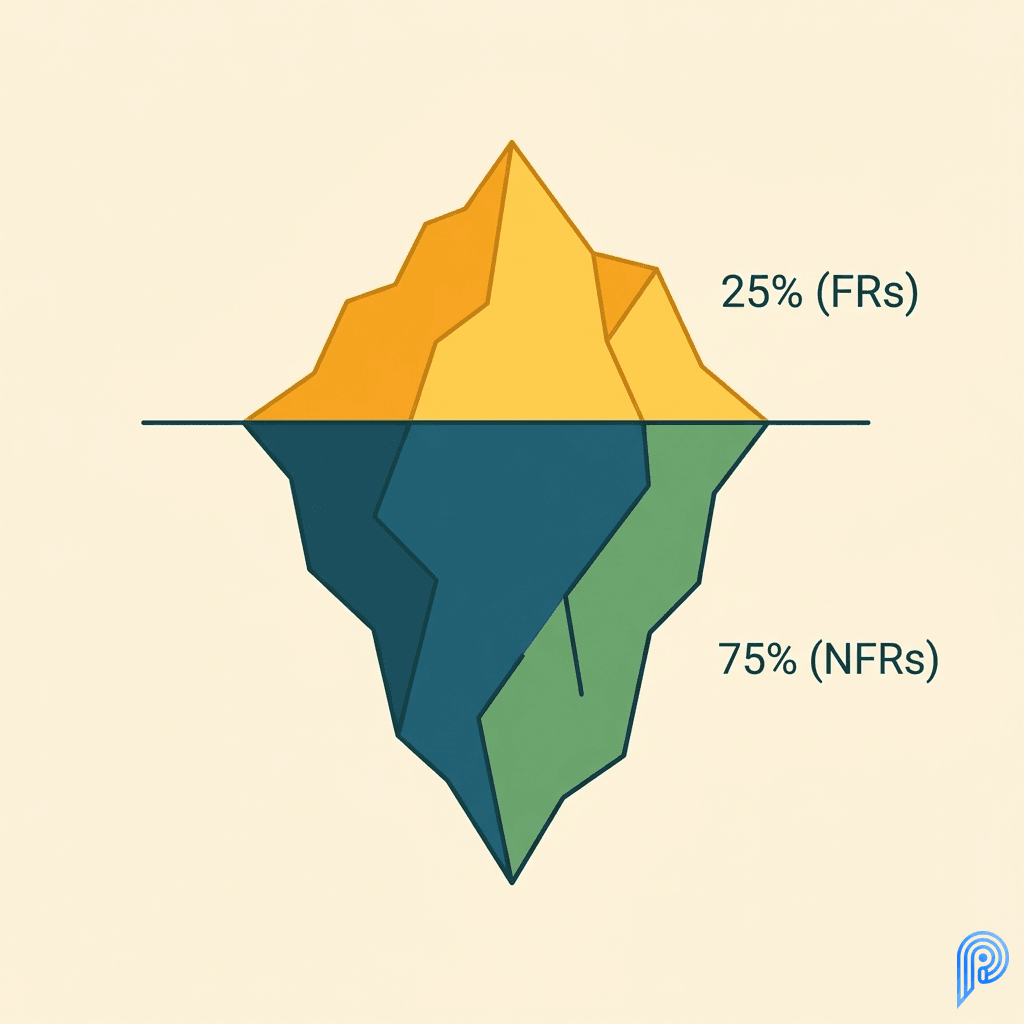
Figure 1: The AI Product Iceberg (25% FRs vs. 75% NFRs)
25% — Differentiated Domain Layer
Your domain logic, proprietary workflows, industry rules, evaluation standards, target-user experience, data configuration, and feedback loops—the parts that make the product valuable and different. These are your functional requirements (FRs)
75% — Production Foundation
Identity and access, integrations, data pipelines, security controls, testing, monitoring, logging, audit trails, deployment, reliability, support, maintenance, governance, and ongoing model or vendor management, and more. These are your non-functional requirements (NFRs)
The exact split will vary, sometimes significantly, based on the product, maturity, regulatory environment, integration burden, reliability requirements, and the amount of reusable infrastructure already available. The point of the heuristic is simple: the visible workflow is often only a fraction of the work required to deliver and operate a production-grade product.
The lifecycle cost can be even more striking. Published estimates vary, but the high upper bound often cited is that as much as 90% of total software cost can occur after the initial launch, when maintenance, enhancements, security updates, integrations, support, and operations take over.
This does not mean you should give up control of the 75%. You still need to own how the system is configured, governed, operated, measured, and improved. You simply do not need to rebuild every foundational capability with in-house talent.
Whether you are a founder or an enterprise leader, the objective is to flip the focus: put most of your attention on the domain layer that defines the business, while using the right combination of internal capability, purchased technology, and partners to support the rest.
Own the Advantage, Not Every Layer
Building strategically does not mean building everything. The goal is to own the domain knowledge, workflows, data, configuration, evaluation standards, customer relationships, and feedback loops that create competitive advantage. You should also own the governance, operating decisions, success metrics, and product roadmap.
That does not require rebuilding authentication, generic cloud infrastructure, model access, logging, deployment tooling, or every other foundation with in-house talent. Those layers still matter, and you remain accountable for how they are configured and operated. But accountability is different from reinventing them.
Domain expertise is the moat only when it is converted into a repeatable product, process, or unique value prop. Expertise becomes more defensible when it is paired with proprietary or privileged data, customer access, implementation experience, embedded feedback loops, trust, and measurable outcomes.
From Efficiency to Multiplication
The reward is not limited to saving time or reducing cost. When organizations deliberately reinvest the capacity AI creates, the result can become a business multiplier.
IKEA offers a useful example. As its Billie chatbot handled nearly half of routine customer-service inquiries, the company retrained thousands of call-center employees to support remote interior-design services. Instead of laying off 8,500 people, they re-skilled, re-deployed, and generated $1.7b in new channel revenue. The value did not come from automation alone. It came from redirecting existing people, product knowledge, and customer relationships toward higher-value work.
Key Results: The IKEA Multiplier
- Challenge: High volume of routine customer-service inquiries.
- Strategy: Re-skilled and re-deployed 8,500 call-center employees using chatbot-released capacity.
- Outcome: Generated $1.7 billion in new revenue through remote interior-design services.
That is the larger opportunity. Use AI to reduce the burden of repeatable work, but do not stop there. Decide where the released capacity can create better customer experiences, new services, faster decisions, or entirely new revenue opportunities.
The next question is how to execute: what should you build internally, what should you buy, and where can the right partner accelerate the journey? We will explore those choices in Part 3.